A Guide to Choosing a Dog Urn (Sizes, Materials & Personalization)
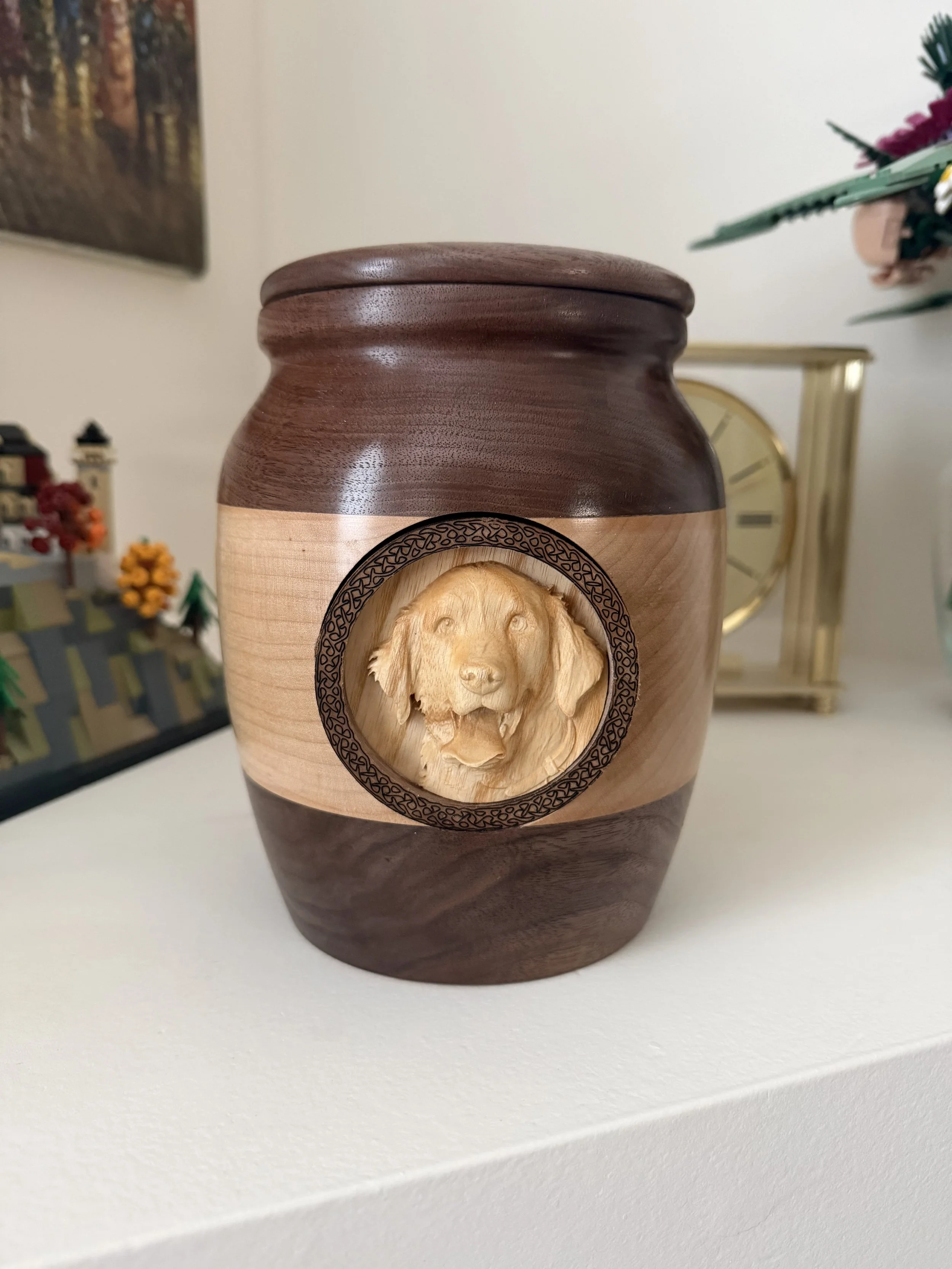
One of the first dog urns we ever made, this one was for our grandpa’s dog, Gretchen.
Losing a dog is losing a member of the family, and choosing how to honor them is one of the harder decisions that comes after. A dog urn is a container designed to hold your dog's cremated remains. This can mean anything from a simple metal or ceramic vessel to a hand-carved wood piece that doubles as a keepsake and a piece of home decor.
This guide walks through the main types of dog urns, how to choose the right size, what personalization options exist, and how to pick something that feels right for your family.
In this guide:
Feel free to contact us if you have questions or to get in touch with our sculptors to learn how to create your own custom urn.
Types of Dog Urns by Material
Dog urns generally fall into three categories, and the material you choose shapes almost everything else about the piece including how it looks, how it feels to hold, and whether it can be personalized.

Wood urns
Wood urns are best for those seeking a warm, natural heirloom piece with intimate personalization or sculpted carving.
They are often turned or box shaped, but vary greatly from studio to studio. In the United States, they are most commonly made from American Cedar due to Cedar’s natural resilience and resistance to rot, but they can be carved from almost any wood. Although each wood has its strengths and weaknesses, we prefer to work with either cedar or a solid hardwood like oak, walnut, cherry, or maple. These wood types bring a warmth that metal and plastic don’t, and because wood can be carved, a wood urn can be personalized with engraving or a full portrait relief of your dog rather than just a nameplate.
Well-made hardwood urns are also built to last for generations, and some wood urns are crafted to be fully biodegradable for families who plan to bury or scatter. As of August 2026, we are the only studio in the country that offers customized relief portrait carvings on wood urns, but since wood carving has been around for thousands of years, learning how to do this was more a combination of disciplines and techniques in a new way than a matter of new technology or machinery. You can see our Craftsmanship page or blog for more details on our wood urn making techniques.
Metal Urns
Metal urns are typically mass produced from bronze or aluminum, which increases affordability at the cost of personalization. They also require almost no maintenance, but low cost occasionally also means lower quality with some families reporting lid fractures or loose pieces secured with poorly bonded glue. Most urns sold in funeral homes, vet centers and online (including those that appear to be wooden or stone), are either metal, plastic, or ceramic. Factories that mass produce metal urns overseas require both large volumes of the same urn type and a lot of time between the order being placed and the finished urns arriving to the US. This means personalization has to happen after the finished urn arrives at the funeral home or storage warehouse. Personalization at that point typically involves either an engraved plaque or using a CNC laser engraver to carve a 2D pixilated image into the side of the urn.
Metal urns are ideal for families looking for a durable low cost alternative to a traditional sculpted urn.
Ceramic Urns
Ceramic urns have been the traditional default for cremation for thousands of years. They are often less expensive, (unless they are handmade and personalized) and typically finished in a simple shape with an engraved plate for a name and dates. They do the job reliably, but they tend to look and feel more like a container than a keepsake, and personalization is usually limited to text rather than imagery.
We are in the process of offering ceramic urns that can be sculpted and personalized like our wood urns. Although we have completed a few ceramic urn works already, the timing and resources required to make each sculpted ceramic urn currently places it above our threshold to offer publicly, but we hope that with some more experimentation and the application of new techniques, we can get a ceramic urn offering together that will combine sculpture with the traditional ceramic form and durability.
For now through, ceramic urns are best for those seeking a moderately priced vessel that will blend into their home earthenware ascetic.
Biodegradable Urns
Biodegradable urns are made from materials designed to break down naturally like certain untreated woods, salt, sand, or plant fiber composites. These are built for families who intend to bury the urn or use it as part of a memorial planting, rather than display it indefinitely.
Personalized and custom urns aren't a niche choice, either, they're already the largest single design category in the pet urn market, accounting for 39.1% of the market in 2024, ahead of both traditional (35.2%) and themed (25.7%) designs.1 Wood is what makes that level of personalization possible: it's the material built to be displayed and carved, not just a container to keep out of sight.
How Big Should a Dog Urn Be?
The standard rule of thumb in the pet memorial industry is 1 cubic inch of urn capacity for every pound of your dog's body weight. This means that a 20-lb dog needs roughly a 20-cubic-inch urn, whereas a 90-lb dog needs closer to 90 cubic inches. Use your dog's weight at a healthy adult size as your guide, not necessarily their weight at the time of passing, which can shift due to illness or age.

A few situations call for sizing up or choosing more than one urn. If ashes will be divided among family members, you'll want either a larger primary urn plus smaller keepsake urns, or several keepsake urns instead of one full-size piece.
Custom & Personalized Dog Urns
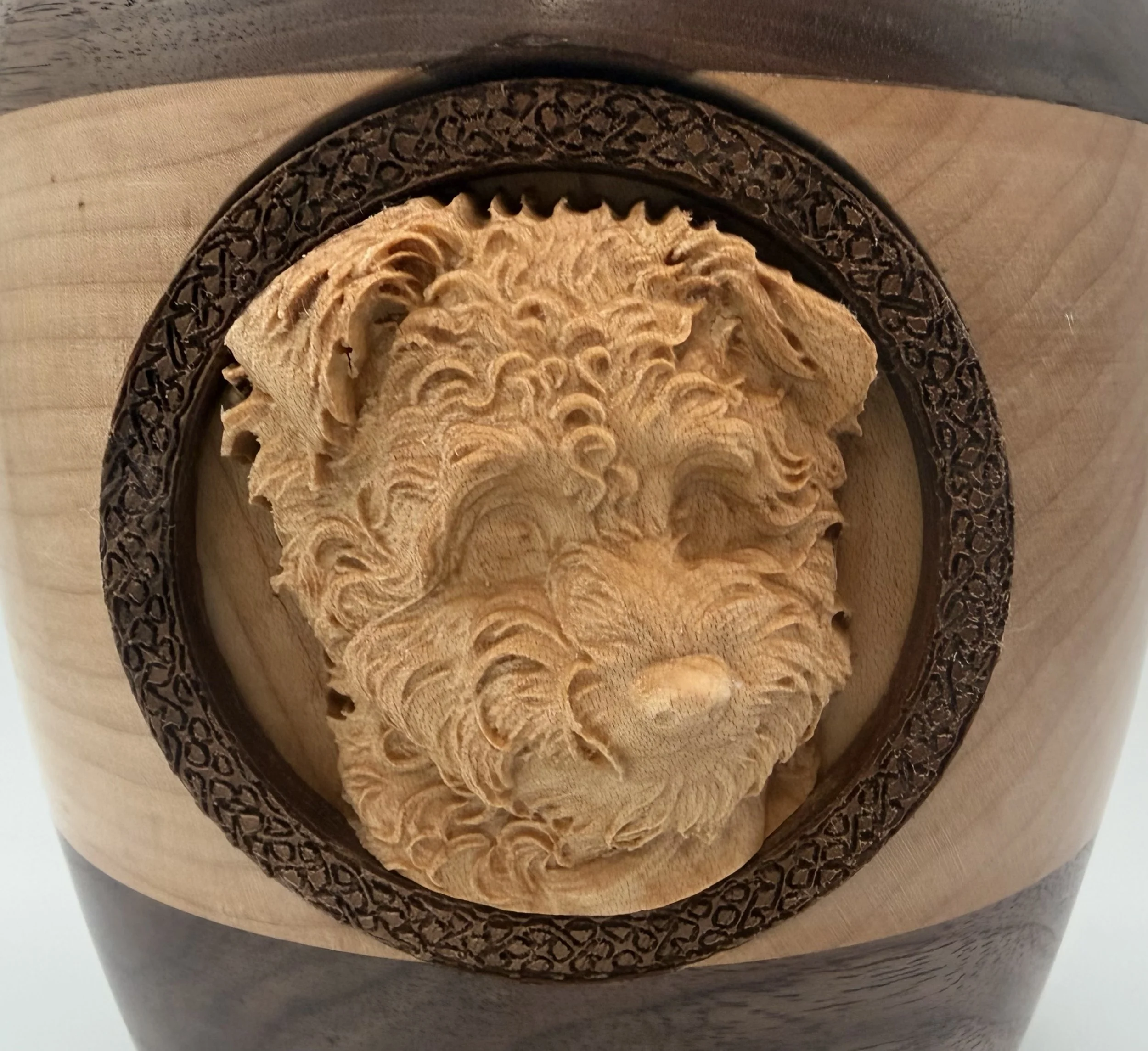
Charlie Engraving
This is an example of a custom engraved wooden sculpture on one of our dog urns.
Personalization is what turns a dog urn from a container into a keepsake. The most common options include:
Name and date engraving — the simplest option, usually a small plate or carved text.
Photo-based portrait relief — a carved likeness of your dog, taken from a photo you provide, capturing individual features like the shape of their ears or the expression in their eyes.
Breed-specific carving or shaping — decorative touches that reflect your dog's breed or personality.
The photo-to-carving process starts with a photo you love. This photo is ideally a clear, well-lit shot that shows your dog's face and expression. We then take this photo and translate it into a hand-carved relief on the urn itself. You can see a better breakdown of how this process works on our Craftsmanship page.
Personalization is what people increasingly expect from a memorial gift. The U.S. personalized gifts market was valued at $9.69 billion in 2024 and is projected to grow to $14.56 billion by 2030, and 70% of gift recipients say a personalized item reflects a deeper bond than a generic one.2 For something meant to honor a specific dog, not just "a dog," that difference matters.
If you are interested in customizing a sculpted urn, you can view our gallery or contact us to see personalization options and start a custom order.
Hand-Carved vs. Laser-Engraved: What's the Difference?
Not all "custom" urns are personalized the same way, and it's worth understanding the difference before you buy.
Laser engraving burns an image into the surface of the wood using a machine. It's fast and inexpensive, but the result is a flat, shallow image ( more like a photograph printed onto the surface), than a true carving. Detail is often limited to what the laser can burn in a single pass, and the image can fade or become less crisp over time as the surface wears.
Three dimensional sculpture carving is slower and more deliberate. A skilled artisan works directly from your dog's photo to carve an actual three-dimensional relief building up depth, shadow, and texture so the piece captures real detail: the curve of an ear, the texture of fur, the particular expression in the eyes. It's a fundamentally different kind of object. At Mont Arbor, each custom photo carving can take up to 40 to 60 hours of skilled work, often involving multiple artisans collaborating on a single piece, finished with hand-rubbed natural oil that brings out the wood's grain and character.
The tradeoff is time and cost: hand carving takes longer and costs more than a laser pass. But for something meant to be kept for decades, most families find the difference is worth it.
Where to Display Your Dog's Urn
Where an urn lives in your home is a personal choice, and there's no single right answer. A few common approaches:
A shelf or mantel keeps the urn visible as part of everyday life and many families choose a spot where they already display photos of their dog. A dedicated memory nook, such as a small table with the urn, a favorite toy, and a framed photo together, creates a more intentional space for remembering. If you've chosen a biodegradable urn, a garden marker or planting site lets the memorial become part of something growing rather than a fixed object. And some families split the difference with a keepsake urn displayed at home while a portion of ashes is buried, scattered, or divided among family members.
There's no timeline for deciding, either. Some people know immediately where their dog's urn belongs, and others take their time finding the right spot.
Frequently Asked Questions
How big should a dog urn be?
As a general rule, a dog urn should hold about 1 cubic inch of capacity for every pound of your dog's body weight. A 20-lb dog needs roughly a 20-cubic-inch urn, while a 90-lb dog needs closer to 90. Most makers offer a few standard sizes to cover small, medium, and large breeds.
Can you personalize a dog urn with a photo?
Yes — many wood dog urns can be personalized directly from a photo. Rather than a flat, laser-etched image, a hand-carved portrait relief captures your dog's individual features in true 3D. Each custom photo carving at Mont Arbor takes 40–60 hours of hand work across multiple artisans to complete.
What's the difference between a pet urn and a dog urn?
"Pet urn" is the broader category, covering memorial containers for any animal — dogs, cats, birds, and more. A "dog urn" is simply a pet urn sized, and often styled, specifically for a dog, such as breed-shaped designs or dog-specific portrait carving. The terms overlap, but "dog urn" signals a more tailored option.
How much does a custom dog urn cost?
Custom dog urn prices vary based on material, size, and the complexity of personalization. Mass-produced metal or ceramic urns are typically the least expensive option, while hand-carved wood urns with photo-based portrait relief cost more, reflecting the many hours of skilled handwork each piece requires. [INSERT ACTUAL STARTING PRICE OR RANGE]
Are wooden urns durable, and how do you care for them?
Yes — solid hardwood urns in woods like walnut, oak, cherry, or cedar are built to last for generations with minimal upkeep. Keep them out of direct sunlight and standing water, dust regularly, and reapply a food-safe wood oil once or twice a year to keep the finish rich.
Choosing a Memorial That Feels Right
There's no single correct way to memorialize a dog. The right choice is whichever one feels true to how your family wants to remember them. Whether that's a simple engraved urn or a fully custom hand-carved portrait, what matters most is that it feels like them.
If you're still working through the loss itself, it may help to know that grief over a pet is real grief. Research on pet bereavement has found it can be just as intense as grieving a close friend, and however you're feeling right now is valid.3
When you're ready, you can explore our custom urn offerings or connect with us to learn more about our sculptures. At Mont Arbor, every piece is hand-carved from solid hardwood and built to hold both your dog's ashes and their likeness for generations.
Sources
U.S. Personalized Gifts Market Size, Growth, Demand, Vendors Analysis 2030 ↩
Grief after a pet's death can be as long-lasting as losing a human loved one, study finds — Maynooth University study (Philip Hyland), published in PLOS One. ↩
